
Back to the drawing board
Posted: January 8, 2012 Filed under: Arduino, Homemade Boiler, Testing | Tags: Arduino, homemade chip boiler, lcd display, LCD problems Leave a commentThe increased air from the second fan did improve the smoke and make the inlet fuel pipe even cooler. It also enabled me to have a viewing port to see if there is flame or if the fuel was adding as expected. But two things happened, the fuel did not flow out of the way so at the bottom of the pipe there was a scree field of pellets which did not move until the previously feed fuel had burned. This situation makes the feeding control very critical. The pace of the feed must be the same as the pace of burning. This alone makes the design unworkable, the process must be more robust than to require advanced combustion calculation, measurement or observation.
The second problem observed was the area of combustion across the pellet field is limited the area of the roughly trapezoidal shape that was formed. This area is significantly smaller than the area of the burner trough. Consequently two things are learned. One the area naturally formed by the falling pellets is insufficient to maintain the water temperature required for my needs, as evidenced by the boilers inability to get past a temperature of approximately 130°F. This alone also requires the redesign since the whole idea is to heat the house. The second conclusion is the area is directly related the heat making capability and thus sizing a burner to a house and feed system is probably quite doable. This seems obvious in statement however, I was thinking that factors such as air volume and burner efficiency would play a larger role. At this point I think I can tailor the BTU’s by burner size and design. I think I will start with the more modest goal of getting the damn thing to work for more than a day.
I’ll admit to being a bit discouraged, however, as January’s calendar said, ” Character consists of what you do on the third and fourth tries”.
To the side see a shot of the burner on the bench in my messy shop. You can see in this shot the approx size of the pellet field that would be burning vs. the potential size of the pellet field if the entire trough was filled.
More combustion air
Posted: January 5, 2012 Filed under: Homemade Boiler, Testing | Tags: Arduino, Arduino boiler control, homeade chip boiler, homemade chip boiler, welding Leave a comment
2nd Fan with slip joint connection
To increase the combustion efficiency a second fan was added. The smoke coming from the boiler was very thick at times and really needed more oxygen. So a second fan was added, to help add more air and help keep the chip feed area cool. The parts slip together and allow a quick look down into the burner area. This allows you to be able to visually check on the feeding, and the fire by simply lifting the fan. So far I am happy with the change and the biggest difference is the ability to see the feed rate appropriateness. Already I want to change the program to allow smaller bites less often because the fuel is backing up the feed pipe. Because of computer issues, the laptop I was using wouldn’t recognize the USB port the Arduino is plugged into more than one or two uploads, I am attempting to switch computers. The 2nd computer at my disposal is running Windows 7. Not nearly as easy to use as XP Pro that I am used to using in opinion.
So, I am having difficulty communicating with the Arduino. I may have to go back to the first computer. Ain’t computers grand? I am a lot happier with a welder and plasma cutter. My weight this morning was 193.8, down 1.9 lbs. Probably water weight although I have stopped drinking beer for a little while. Ham sandwich in every bottle so a friend once told me.
Burner Improvments
Posted: December 19, 2011 Filed under: Arduino, Homemade Boiler, LCD display, Testing | Tags: Arduino, Arduino boiler control, homeade chip boiler, homemade chip boiler, lcd display, LCD problems, welding Leave a commentA friend and excellent engineer visited over the weekend and between us we decided to improve the burner a little. The first change we decided to make was to add some insulation. I measured the temperature around the outside of the boiler with a non contact thermometer at approx. 350°F in the area of the firebox. The mounting plate that holds the burner was approaching that temperature as well. The air box was lower but still this is an excessive temperature. The Auger pipe was solid from the hopper to the burner unit and since I have both 4″ pipe and 4″ tube we decided to make a thermal break in the auger feed for additional safety. The 4″ pipe even though it is surrounded by the air box eventually gets warm and since the feed auger has a fair amount of room between the auger and the pipe there is a certain amount of fuel that remains in the pipe and at shut down this can smolder. So to remove this problem and make the unit more safe a redesign was initiated. Adding insulation between the air chamber and the burner with the addition of a thermal break prompted us to take the unit apart, check it over and see how everything was faring as well as make improvements. But of course after the burner and hopper were cut apart and on the bench more improvements were noted. Most of the improvements now fall into minor design for manufacturing type areas, maybe a little less welding and a little more tabbed nut and bolt assembly so minor changes can be made more quickly. Of course being able to pull the auger feed away from the burner assembly without unbolting anything will be a big change and improvement. I am going to make the air box bolt on as well. Should be reassembled for another test on Wednesday.
Of course it wouldn’t be a weekend if we didn’t play with the software. We added a For loop to the thermistor function to improve the accuracy. I added an array to smooth the results using a moving average. But most importantly we found the lingering problem with the LCD characters being garbled. It was a wiring issue. Now fixed it has run 24hours without a problem and I am confident it will stay fixed now. The next step will be to add a capacitor if the problem resumes. I am quite confident it will not be a problem however since it looks more solid even. There is less flickering and more solid character display. So all in all a fun and productive weekend.
Overnight run successful
Posted: December 17, 2011 Filed under: Arduino, Homemade Boiler, Testing | Tags: Arduino, Arduino boiler control, homemade chip boiler, lcd display, LCD problems Leave a comment
Improved wiring and Arduino mounting, yes that’s a sparkfun box
Successful overnight run, software required major tweaking but the boiler ran without involvement overnight. I did supervise the process but nothing got hot or got out of the control parameters. My only complaint at this point is chip economy. The setpoint I chose was 160°F which is probably too high for the weather we are having now. The overnight temperature was approx. 32°F and so the circulator just didn’t use that much heat. So I think I will add some software changes to the program. The first to be the addition of a variable called setpoint so I can easily change the set point temperature. Ultimately I need to add a outside temperature thermistor to the internal PC board so the Arduino can determine it’s own set point based on outside temperature. Some other ideas are to relay the draft fan so the flames aren’t quite so robust all the time as well as physically remaking the burner unit to be smaller. All in good time. So far software changes are making a difference so I will try that first.
The flames look consistently great. The burner is working really well. Still having LCD problems and my main goal after getting the unit to run is building a second unit so I can make the unit run the Hot water thermostat as well as try to duplicate the LCD character problems. Of course I could probably call the manufacturer of the LCD to see if they have any technical support. That will be a Monday project.
Above is a picture of the somewhat improved but not final configuration. At least the wires are neat and the smoking problems have been overcome. The new door is pictured, and the burner flame. A photographer I am not.

New Fire door with over center latches and fiberglass rope sealing
3rd Burn Test
Posted: December 13, 2011 Filed under: Arduino, Homemade Boiler, LCD display | Tags: Arduino, Burn test, homemade chip boiler, hysteresis, relay chatter Leave a comment
Boiler control box with manual feed control
Success! At least compared to the last burn. Virtually no smoke, although some paint burned off. There is still some lingering smell from duct tape and caulking but overall much better, with no smoke. The burn start/ ash clean out door needs to be rebuilt with hinges, so that is still a problem area, but overall great. The program ran reasonably well, however, I added some hysteresis to the circulator loop to keep the relay chattering to a minimum. At this point I have the oil fired burner locked out, but I think I will reduce the temperature set point of the boiler and it just won’t come on unless needed. There are a list of small items that are required to run a 24 hour test, but I can probably do most of these things tomorrow and be able to be successful with this tomorrow afternoon. One thing that still needs to be done is shop cleanup. But for now, YEAH! Thanks
to friends!

Boiler installation for testing
Arduino thermostat
Posted: October 31, 2011 Filed under: Arduino | Tags: Arduino, homemade chip boiler, welding project Leave a commentEarlier I finished the piping for the the two additional zones. A quick recap, one zone will allow a boiler to heat the tank that is normally heated by solar. The second zone is really not a zone but the piping and circulator pump that will add heated water from the chip boiler.
The solar water tank, or solar thermal store has two coils in it, the first coil is heated by the solar loop on the roof. This coil is physically lower in the tank so that the heated water will rise and the sensor controlling this coil is lower as well. This allows the maximum storage from the tank from solar at all times. The second coil and sensor that is intended to be heated from the boiler is mounted higher. The water at the top is hottest and therefore the least amount of energy will be needed and the maximum amount of free energy is used first. Of course solar is not free, it still requires a circulator pump but I assume it to be negligible and therefore in this context free.
Knowing this and assuming that I am going to use an Arduino microcomputer in the process anyway, I am intending to implement the solution in two steps. The first step to wire and shrink wrap a thermistor and run the thermistor back to a breadboard, and display the temperature on an LCD. If the temperature is below a certain value, digital write to a relay to turn on the circulator pump. If the temperature is good, do nothing.
In the second iteration of the solution my plan is to add a time chip to the system and make the process more efficient. The logic is this:
8am, no real need for hot water, and there is a good chance the solar will heat the water.
4pm, heat water and maintain until 8pm if needed.
8pm-8am maintain a minimum, lukewarm temp. We’re not a shower in the morning family. Of course on the weekend the program will have to be different.
To implement this 2nd iteration a real time chip will be required. I have found a few, one at sparkfun.com
http://www.sparkfun.com/products/10160, $19.95

and a second one at
http://macetech.com/store/index.php?main_page=product_info&cPath=5&products_id=8

I am inclined to the second link, the board is cheaper with a built in battery holder and battery shipped with the product for $14.99
And the yourduino option for $9.00
http://arduino-direct.com/sunshop/index.php?l=product_detail&p=48
http://adafruit.com/products/264

Also $9.00
Any opinions?
Progress-Goal for the week
Posted: October 31, 2011 Filed under: Homemade Boiler | Tags: Arduino, homemade chip boiler, welding Leave a comment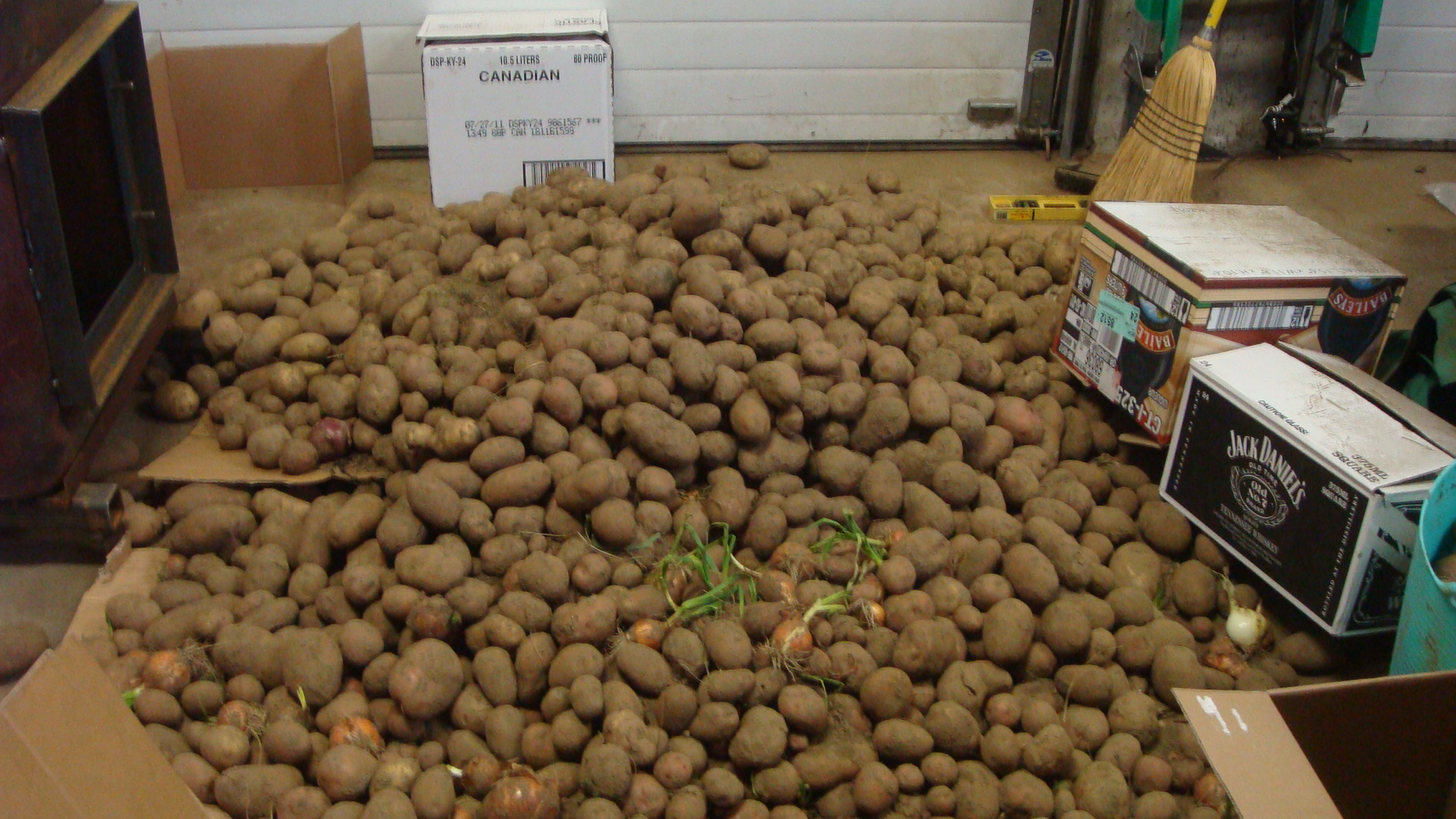
Potato Harvest drying on floor
I harvested potatoes last weekend with the girls and the floor was covered. I had to clean up so I could work without stepping on vegetables. So that was job one on Sat morning, get more liquor boxes and get things cleaned. Finally finished that with help from the girls on Sunday morning. It snowed over the weekend so Sunday was spent plowing and going to a party at a friend’s house. On Saturday, with help from my 11 year old helper,I did get one half of the circulation loop for the heating of the solar tank installed.

Clean floor after Potato
Today’s goal is to finish installing the loop and run stub piping through the wall to where the chip boiler will be installed. I want to install the loop in the solar water tank to allow for more energy storage. This will allow more flexibility when the microcomputer is deciding where to put the heat from the chip boiler. Finishing the loop will also allow the Arduino Uno to be the thermostat controller hooked to the Boiler Boss. With a thermistor and LCD added to a relay board the Arduino can be the thermostat to run the zone. It seems to me this would be a great way to test the Arduino since all that can happen if the thermostat fails to work is a cold shower. Of course this assumes that the solar loop didn’t heat the water sufficiently and the solar can still heat the water hot enough for a shower on a good sunny day.
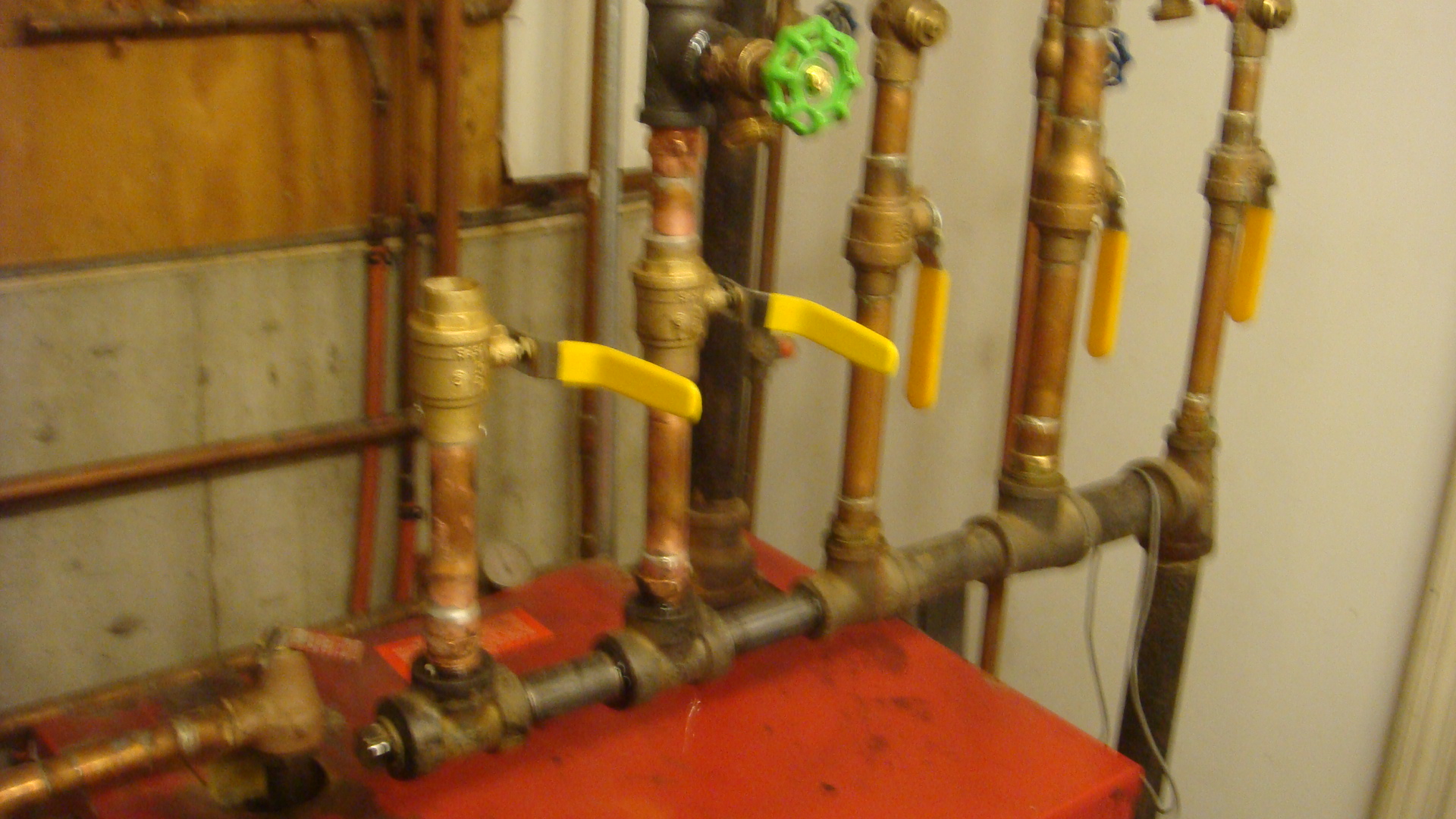
Return manifold with piping from heating coil in Solar tank and stub from chip boiler
The boiler boss is one central control unit that contains all the relays for the zones. This box controls all the circulator pumps and the new circulator pump needs to be wired into this and the Arduino wired in as a thermostat.
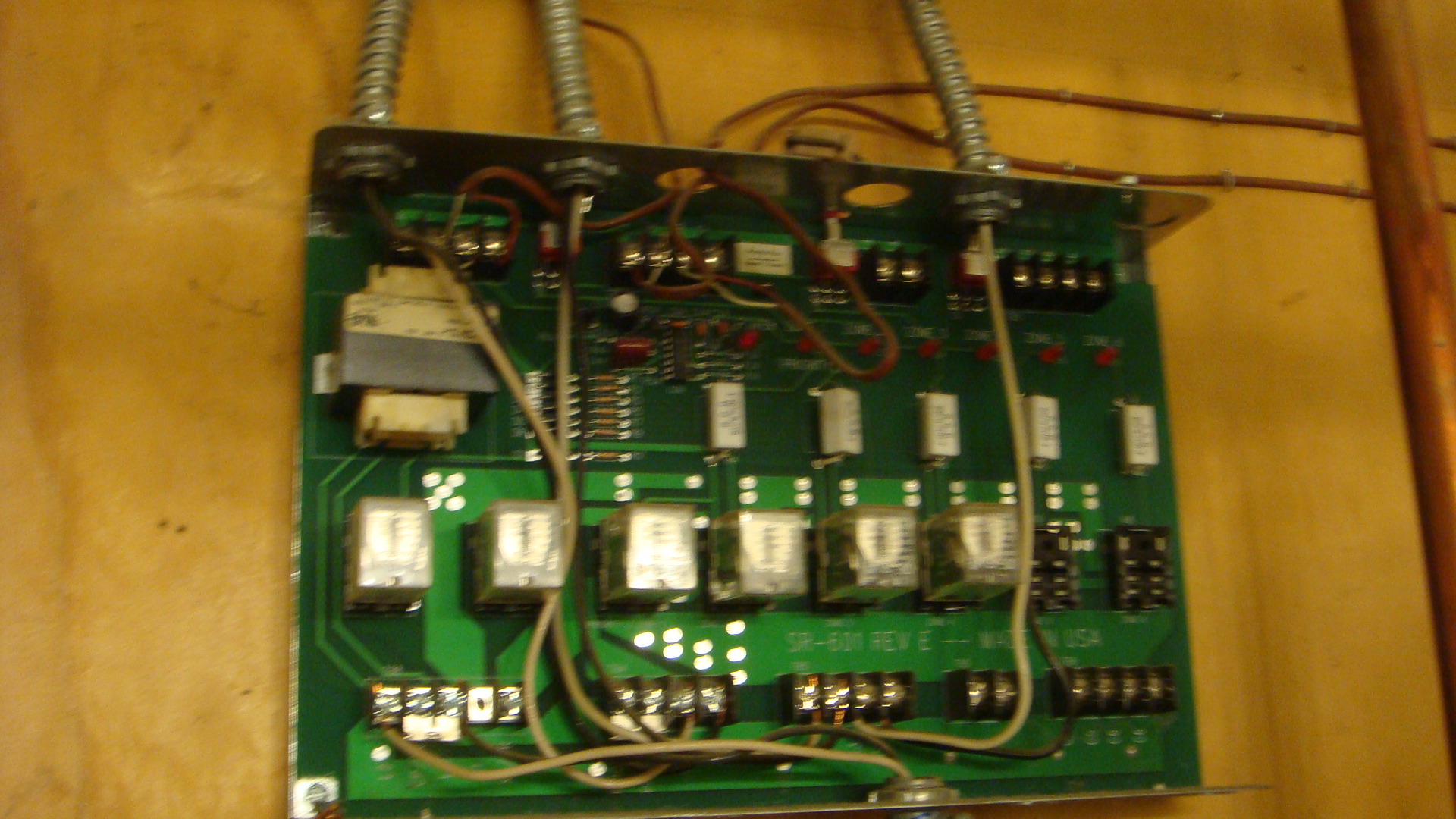
Boiler boss with Cover removed
So this weeks goals are simple: 1) Finish the solar hot water tank loop, wire it in and test with an Arduino controlling the zone, acting as the thermostat. 2) Apply the sealant to the chip boiler and test for leaks. 3) Work on the Chimney penetration through the rear wall of the shop for the chip boiler. This will be a straight 4″ pipe out since there is forced draft.
I got some good comments from a friend concerned with the temperature of the return water so I got a fresh battery for my non contact thermometer and took some temperature measurements of the zone water at the point leaving the circulator and just above the return manifold so here they are: 113 out and 98/99 back, not a lot of difference. The outside temp is approx. 30 (all temps F).
I am having a difficult time removing the end plug for the upper manifold, this is a 3/4″ black iron plug, I am thinking of using heat, any other suggestions, I am trying this plug with a 24″ pipe wrench, I am afraid if I try to use a cheater I will break something.
 frugaltinker